
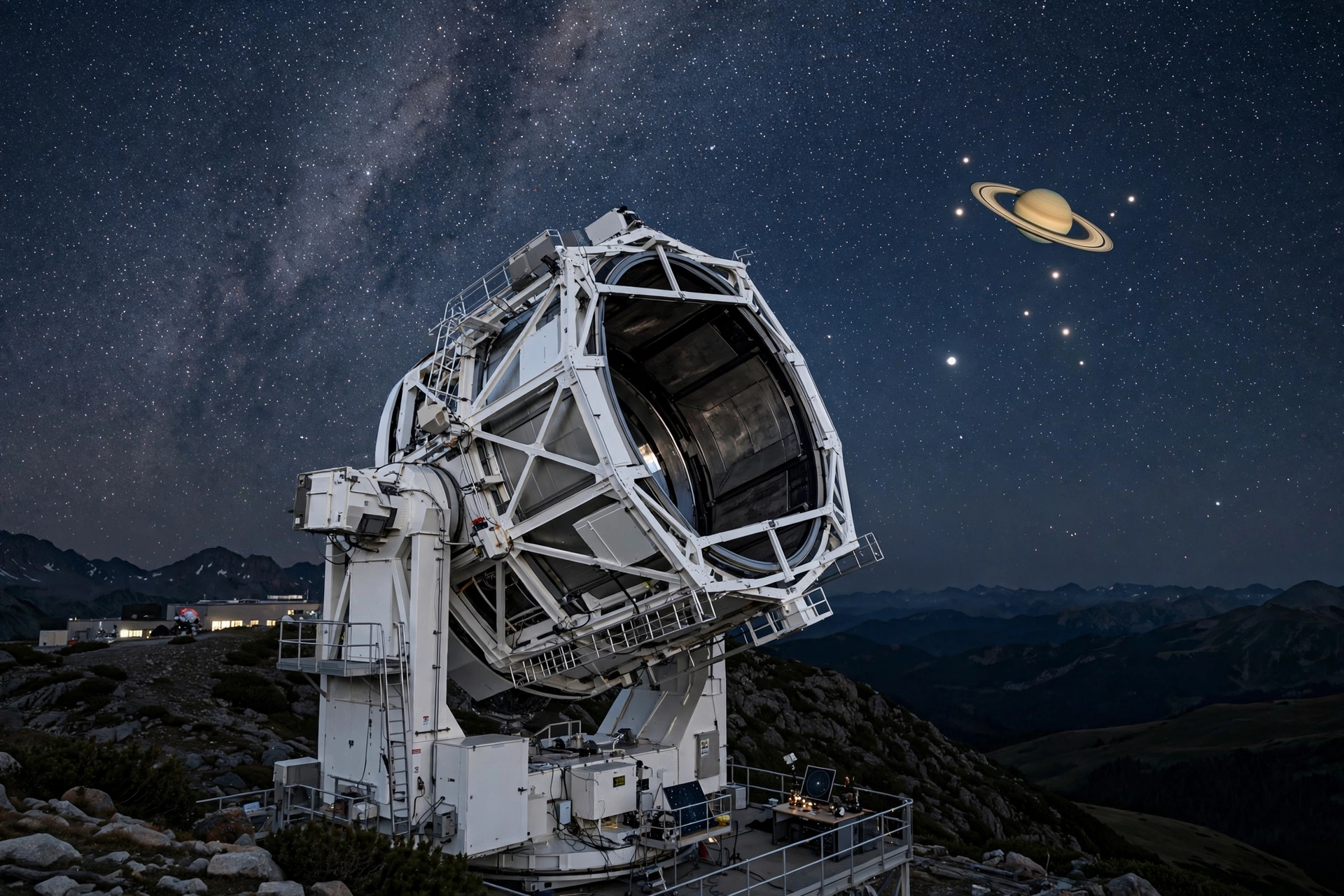
Just when astronomers thought Saturn’s family was fully counted, it has grown dramatically once more. A total of 128 newly confirmed moons have been added to the ringed planet’s roster, bringing its official tally to 274 — the highest moon count of any planet in the solar system by a considerable distance.
The confirmations follow years of observations with the Canada-France-Hawaii Telescope, where a survey team patiently recorded the region of space around Saturn. Researchers at the University of British Columbia were among those who turned stacks of faint images into secure orbits, the essential requirement before the International Astronomical Union recognises a moon.
Small worlds at the edge of visibility
Anyone picturing 128 new versions of our own Moon should adjust their expectations. The latest additions are irregular moons: dark, rocky lumps typically a few kilometres wide, circling Saturn at great distances on tilted and often backwards orbits. They are less like the Moon and more like captured rubble that has accompanied the planet ever since.
Their faintness explains why they hid for so long. Each one reflects so little sunlight that only by combining many exposures — and tracking the same patch of sky across different years — could astronomers be sure the specks were real, moving, and bound to Saturn.
Why the count matters
A bigger catalogue is more than a trivia record. The way these moons are distributed tells scientists how Saturn captured material from the early solar system and how collisions later ground larger bodies into swarms of fragments. Families of moons sharing similar orbits are, in effect, debris fields from ancient smash-ups, and each new member helps map the original event.
Records also have a habit of changing how we think about familiar systems. Readers following our guide to Starlink access limits and satellite internet control will know the pattern from nearer to home: the space around a planet, natural or artificial, is busier and more complicated than it first appears.
Confirmed means confirmed
It is worth stressing that these are not speculative candidates. To earn recognition, a moon’s orbit must be known well enough that astronomers can predict where it will be in future — the difference between seeing something once and genuinely discovering a world. That verification process is slow, but it is what makes the figure of 274 dependable.
Could there be still more?
Probably. Every improvement in telescope sensitivity has expanded Saturn’s retinue, and researchers suspect smaller fragments remain below today’s detection limits. Future surveys may push the total higher still, although each generation of instruments faces diminishing returns as the remaining moons grow ever fainter.
How to think about the number 274
For readers trying to place the figure in context, consider that for most of human history Saturn was known to have no moons at all. Titan, the largest, was spotted in 1655, and the count crept upwards one telescope improvement at a time for more than three centuries. The jump to 274 has happened almost entirely within the era of digital detectors, which shows how much of astronomy’s progress is really progress in seeing rather than in travelling.
It also means the solar system taught in schools is a simplified sketch. Alongside the eight familiar planets sits a far richer architecture of rings, families and captured fragments, most of it mapped only in outline. Saturn’s newly expanded roster is the clearest illustration yet that the neighbourhood we live in is still being charted — and that the charting itself is one of the great ongoing projects of science, carried forward survey by survey, season by season, without any need for fanfare.
What will not change is the scale of the achievement. Saturn, watched by skygazers for more than four centuries, was still hiding over a hundred moons in plain sight. The solar system’s most photographed planet has reminded everyone that discovery does not require travelling somewhere new — sometimes it only requires looking more carefully at somewhere familiar.
1 thought on “Saturn’s Family Grows Again as Astronomers Confirm 128 More Moons”