
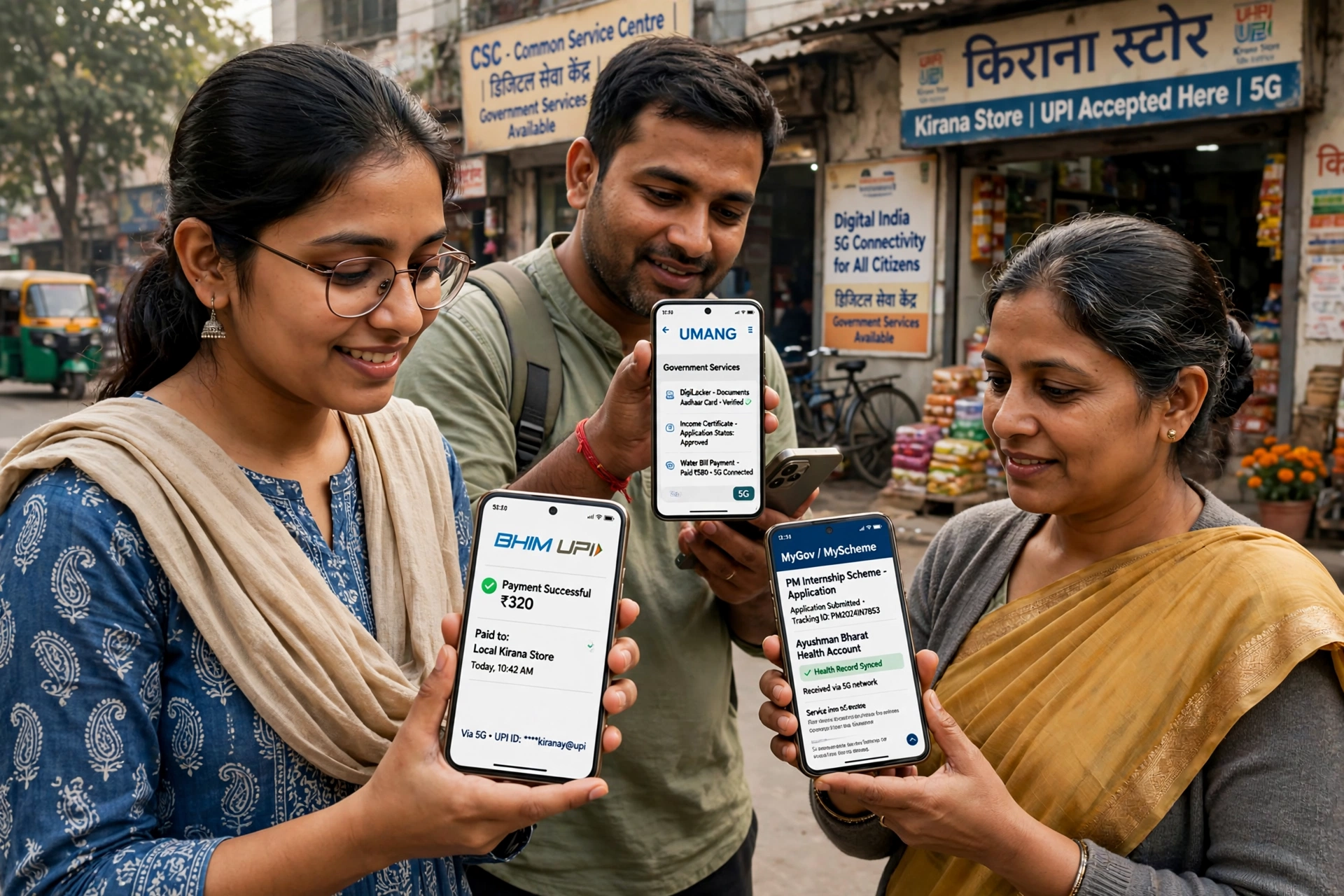
A farmer checking a subsidy payment on a phone, a student downloading a certificate without visiting a government office, a street vendor accepting a payment in seconds with a QR code — these ordinary moments describe a profound change. Across India, fast mobile connectivity, especially 5G, combined with digital public infrastructure, is changing how people prove who they are, access services and move money.
This is not just a story about faster downloads. It is about public services designed to work on a phone, at scale, for more than a billion people.
Connectivity That Reaches Further, Faster
India’s 5G rollout has been among the fastest in the world. At India Mobile Congress 2026, the communications minister said India already has hundreds of millions of 5G users and aims to reach one billion by 2030, as reported by YourStory. Cheap data — among the lowest-cost in the world — has been just as important as speed, because a service people cannot afford to use does not transform daily life.
Broadband and rural connectivity programmes have extended that reach beyond big cities. Official updates summarised by the Press Information Bureau describe broadband subscribers passing one billion, BharatNet connecting large numbers of village councils, and UPI completing a decade as the backbone of everyday digital payments.
Digital Identity Makes Services Portable
One identity, many services
Digital identity systems allow a person to verify themselves without carrying a folder of photocopies to every office. Linked to mobile access, that identity unlocks bank accounts, welfare benefits, insurance, education records and business registrations. For migrant workers and rural residents especially, portability matters: services follow the person, not the place where a paper file happens to sit.
Documents without the queue
Digital lockers and online certificates mean driving licences, educational records and government-issued documents can be shared securely when needed. That reduces lost paperwork, middlemen and repeat visits — and creates a verifiable record that employers, banks and institutions can trust.
Government Services Move Online — and Mobile
Thousands of central and state services are now available through mobile apps and web portals: applying for documents, paying utility bills and taxes, booking health appointments, tracking pensions and receiving direct benefit transfers into bank accounts. Direct transfers are particularly significant, because money reaching a beneficiary’s account directly reduces leakage and delay.
Common service centres and assisted digital points still play a vital role for people who are new to smartphones or need help in a local language. The most successful model is not “online only” — it is online by default, with human help available when needed. Explore our recent reporting here for more on how connected services are evolving.
Payments: The Change Everyone Can Feel
No part of this transformation is more visible than payments. UPI turned a phone into a payment device for everyone from large retailers to roadside tea stalls. Instant, low-cost transfers changed cash habits, helped small businesses keep digital records, and made it easier to receive wages, remittances and government support.
That payment layer also supports other services: paying a bus fare, recharging a meter, donating, splitting a bill or paying a school fee now happens in the same simple flow. When payments are easy and trusted, more of the economy can participate formally — and small sellers gain a transaction history that can help them access credit.
What 5G Adds Next
5G’s real contribution is capacity and responsiveness in crowded, real-world conditions: reliable video consultations for telemedicine, live online classes without constant buffering, faster uploads for small businesses, connected logistics, and public services that can handle millions of simultaneous users during deadlines and emergencies.
There are still gaps to close — device affordability, digital literacy, online fraud, privacy and reliable connectivity indoors and in remote areas. Technology alone does not guarantee inclusion; clear consent, strong data protection, accessible design in Indian languages and effective grievance redress are essential if trust is to keep pace with adoption.
A Daily-Life Revolution, Still Unfolding
The measure of this transformation is not a launch event or a speed test. It is time saved, journeys avoided, payments received on time and services reached without influence or intermediaries. As 5G coverage deepens and digital public platforms mature, that everyday convenience is becoming the normal experience for hundreds of millions of people — and a model other countries are studying closely. Read more in another recent story on this site.